Innovation and Experimentation in Values-Based Preservation at Taliesin West
Frank Lloyd Wright Foundation | Mar 24, 2026
Q&A with Jennifer Gray, Vice President of the Taliesin Institute, and Rebecca Barron, Director of Preservation.
Taliesin and Taliesin West were always places of ongoing experimentation and change, qualities seemingly in tension with historic preservation. How does the Frank Lloyd Wright Foundation balance preservation with contemporary use to remain living landmarks? Jennifer Gray, Vice President and Director of the Taliesin Institute, sits down with Rebecca Barron, Director of Preservation, to talk about values-based preservation and how this approach informs a long-term project to restore the fabric roofs at Taliesin West — with implications for heritage and contemporary concerns around climate change.
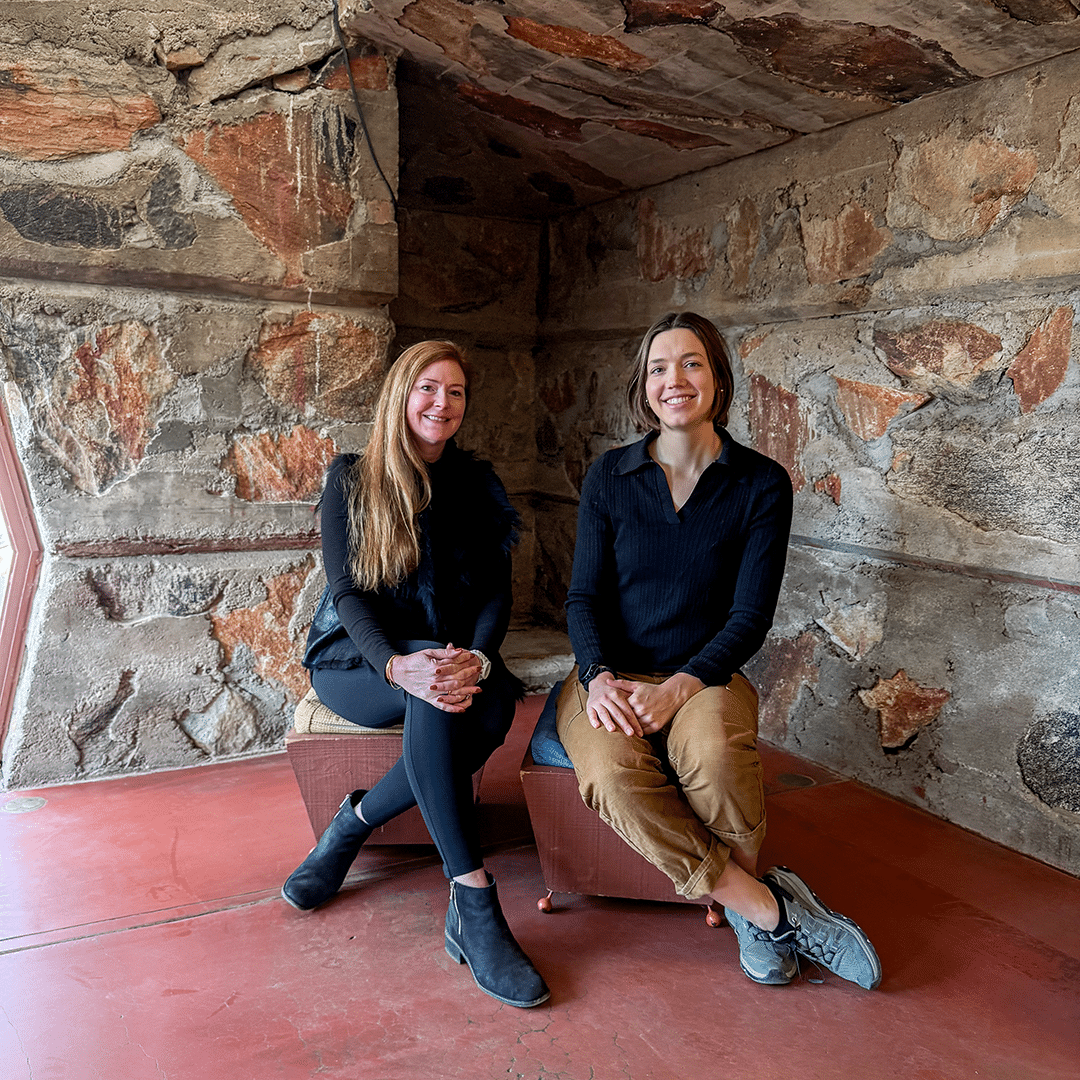
Jennifer Gray and Rebecca Barron
JG: What is the fabric roof project at Taliesin West?
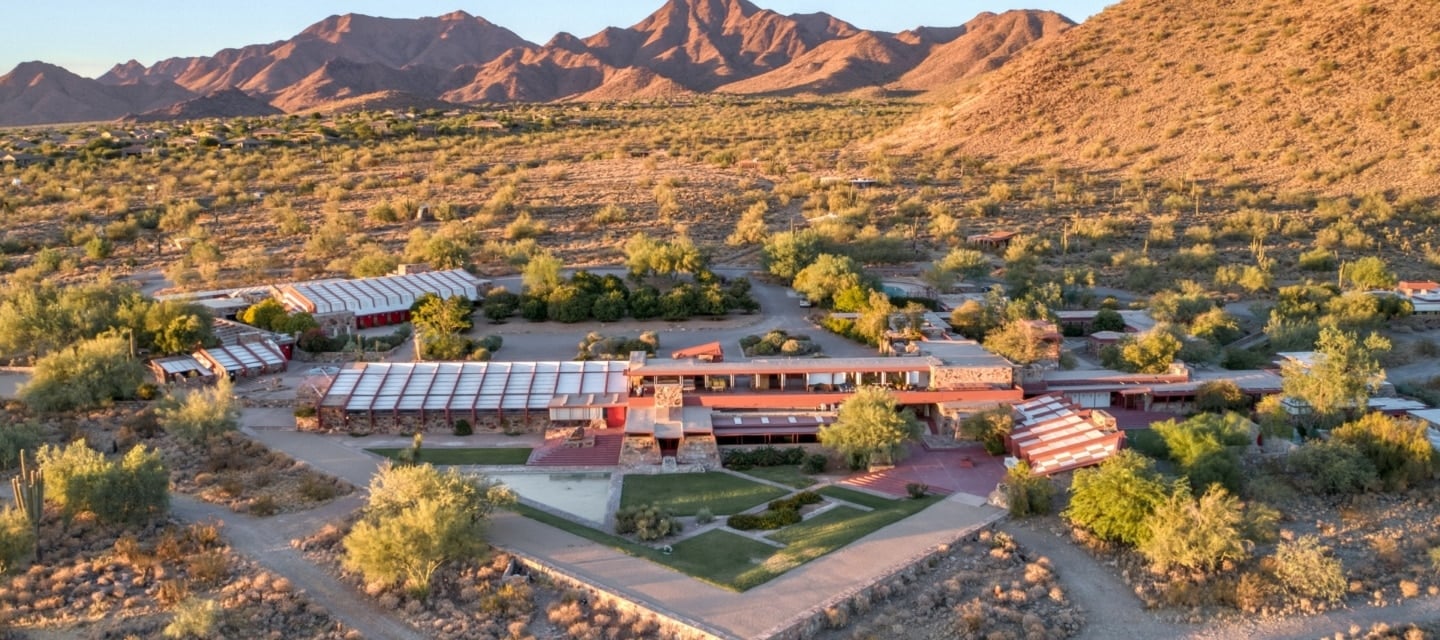
RB: For over a decade, the Foundation has been working on a project to restore the operable fabric roof system at Taliesin West. We have spent these years researching, designing, collecting environmental data and creating energy models, and most recently, 3D printing prototypes to understand the viability of replacing the fixed acrylic panels installed in the 1990s with contemporary, high-performance fabric that was not available during Wright’s lifetime. This new material has superior thermal performance, insulative qualities, and durability compared to the original canvas that Wright used. The overall goal is to restore the aesthetic and functionality of the original roof system while improving the comfort of our interior spaces for visitors and using natural ventilation during the winter months as a passive cooling strategy.
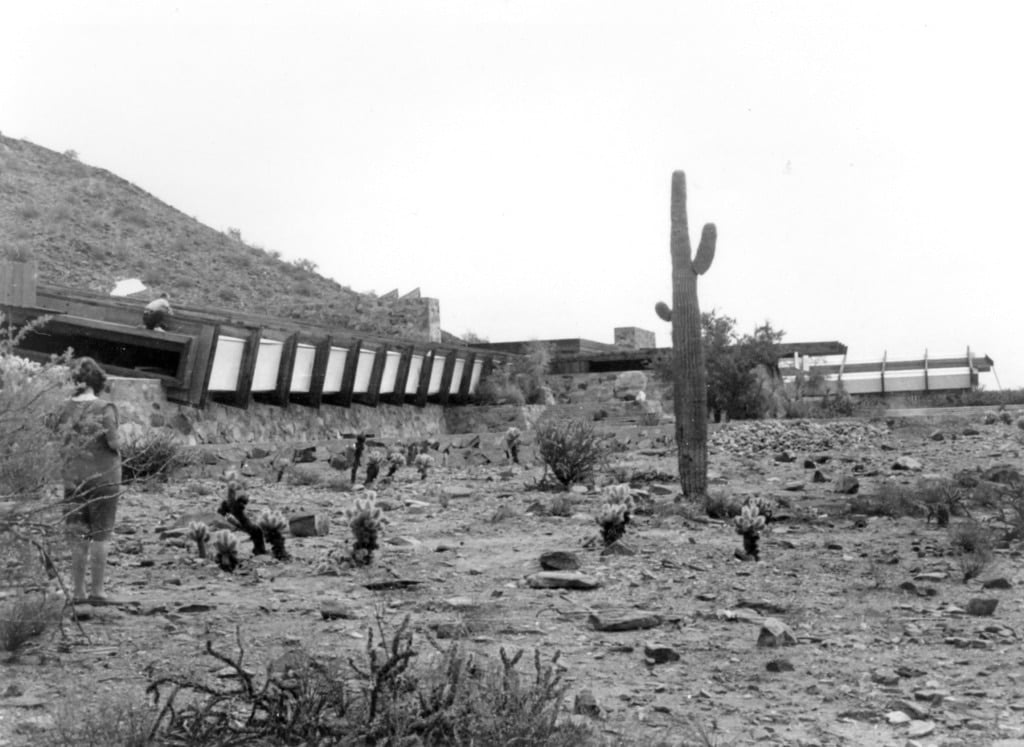
Drafting studio view from the west, ca. 1940. Photo: Cornelia Brierly, 3803.0131
JG: Take us back to 1938 when Frank Lloyd Wright started building Taliesin West. What was Wright’s original intention for the site? How did the architecture respond to the desert environment?
RB: Wright always considered Taliesin West to be a winter camp. When he started visiting Arizona in the late 1920s, he was struck by the beautiful yet hostile environment and sought to adapt his philosophy of organic architecture to the Sonoran Desert. He studied nature and learned that desert plants had evolved to survive the intense sun and heat of their environment. He called this “sun acceptance” and noted that it was a condition of survival in this climate.
Taliesin West was a laboratory for him to experiment with these ideas. Its walls were constructed of desert masonry, using large boulders found on the site and a concrete mix made of water, sand, and Portland cement. Desert masonry has a high thermal mass, keeping the interior spaces cooler during the day and retaining heat overnight. Desert masonry also integrates the architecture of Taliesin West into its landscape. The roof system was comprised of rectangular canvas panels. These were lightweight, translucent, and could be opened and closed to modulate air flow and temperature. In contrast to the permanence of the walls, the ephemeral nature of the canvas and wood roof system suggests a more transient relationship with the desert. The site was more camp than permanent residence. Wright and his apprentices only wintered at Taliesin West, migrating back to Taliesin in Wisconsin during the summer months. The canvas panels were removed seasonally and stored, to be repaired and reinstalled the following year when the Fellowship returned to Taliesin West and set up camp.
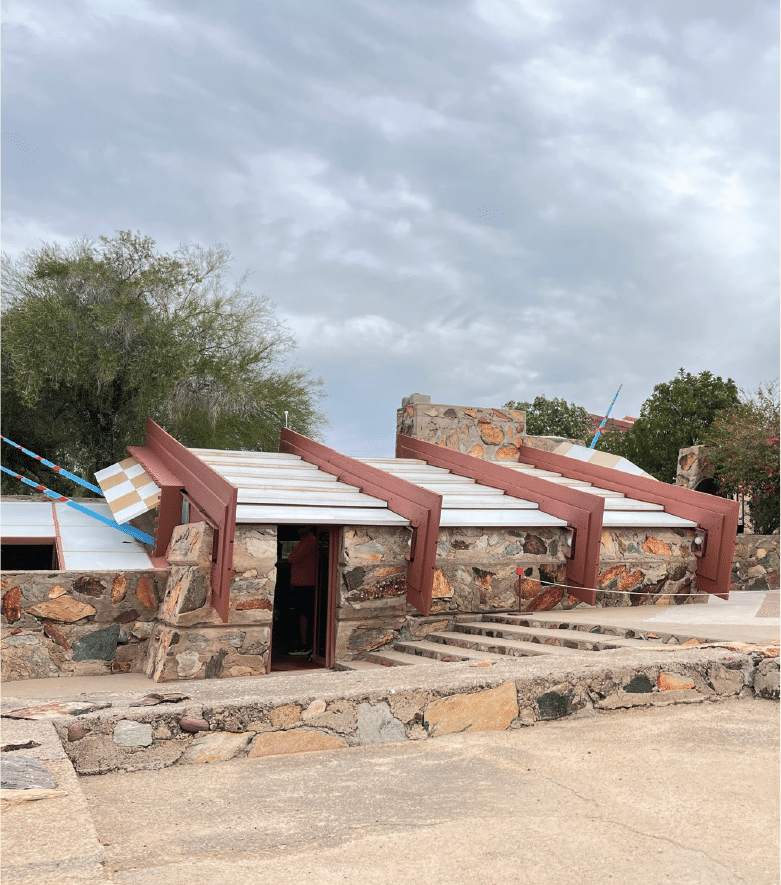
Frank Lloyd Wright, Taliesin West, View of Wright’s Office Acrylic Roof, 2023.
JG: What changed? Why are there no longer fabric roofs at Taliesin West?
RB: After Wright’s death in 1959, the Fellowship increasingly wanted to spend more time in Arizona, and they started making changes to Taliesin West to allow for year-round occupation. Glass was gradually added until most of the interiors were enclosed; the operable fabric roof panels were replaced first with fixed fiberglass panels and then insulated acrylic panels. Some of this work started during Wright’s lifetime, but much of it came later.
The gradual enclosure of Taliesin West was an attempt to make the ephemeral camp more permanent. It also allowed for the introduction of mechanical systems — namely air conditioning — that made the site habitable during the summer. These changes continued Wright’s experiment in desert living but with different materials, technologies, and uses in mind. At the same time, these changes were a departure from Wright’s original intentions for an environmentally responsive architecture. There is a growing awareness about environmental changes and energy consumption that historic preservation has a responsibility to address.
JG: Why is the fabric roof project so important today for the field of historic preservation
RB: The fabric roof project came out of an energy audit we conducted in 2011, which identified the roofs as one of the key contributors to energy inefficiency on the site. The current acrylic roof system is nearing the end of its serviceable life. It needs to be replaced. And so, this presented us with an opportunity to consider how we might restore it to a fabric roof system that could be more responsive to its environment utilizing new materials, such as PTFE fabric that can withstand the harsh sun and has been used in the Middle East and elsewhere. Through this exploration, it was determined that we needed a framework across the board to guide our preservation decisions. In 2015 we adopted a values-based approach to historic preservation through our Preservation Master Plan, which can be found on our website. This approach gives us the flexibility to think about preservation more holistically, much like Wright thought about architecture holistically.
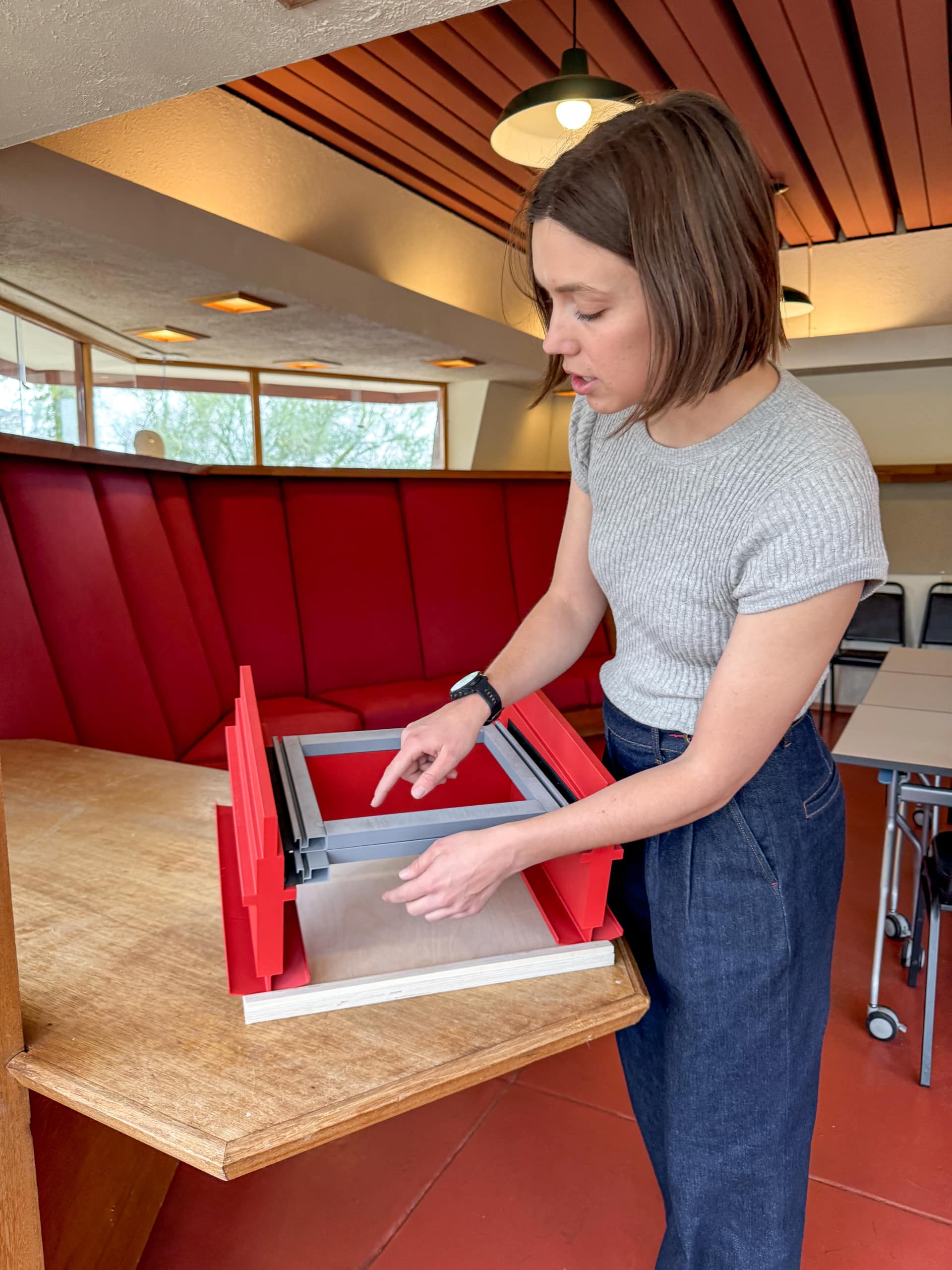
Barron explaining the new panel system designed by Harboe Architects, using 3D printed model by 180 Degrees Design + Build. Modeling and printing done by Guillaume Evain and Evan Emery.
Rather than replacing the roof system with the same canvas Wright used during his lifetime — which deteriorated rapidly in the desert climate and would be unsustainable for our uses today — values-based preservation allows us to consider using new materials to restore the experience of being in an open-air, temporary camp. In values-based preservation, we not only consider the physical materiality, aesthetics, and structure of the property in our decisions. We also preserve the intangible heritage of the site. In this way, the fabric roof project continues the ongoing process of innovation and experimentation that was always at the heart of this place.
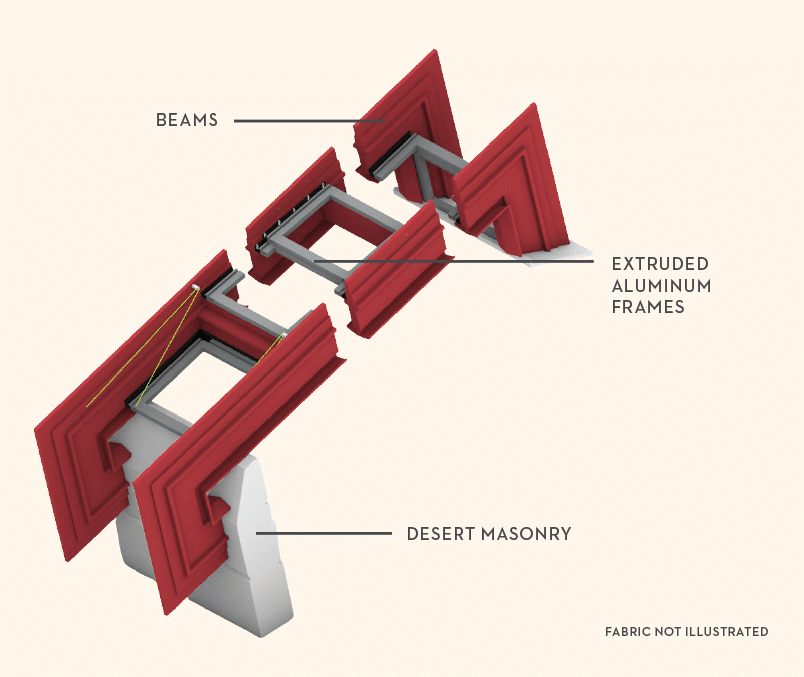
3D computer model by 180 Degrees Design + Build depicting the three sections of a typical roof bay that will be 3D printed as prototypes, including the one shown above, to test the constructability and operability of the designed system.
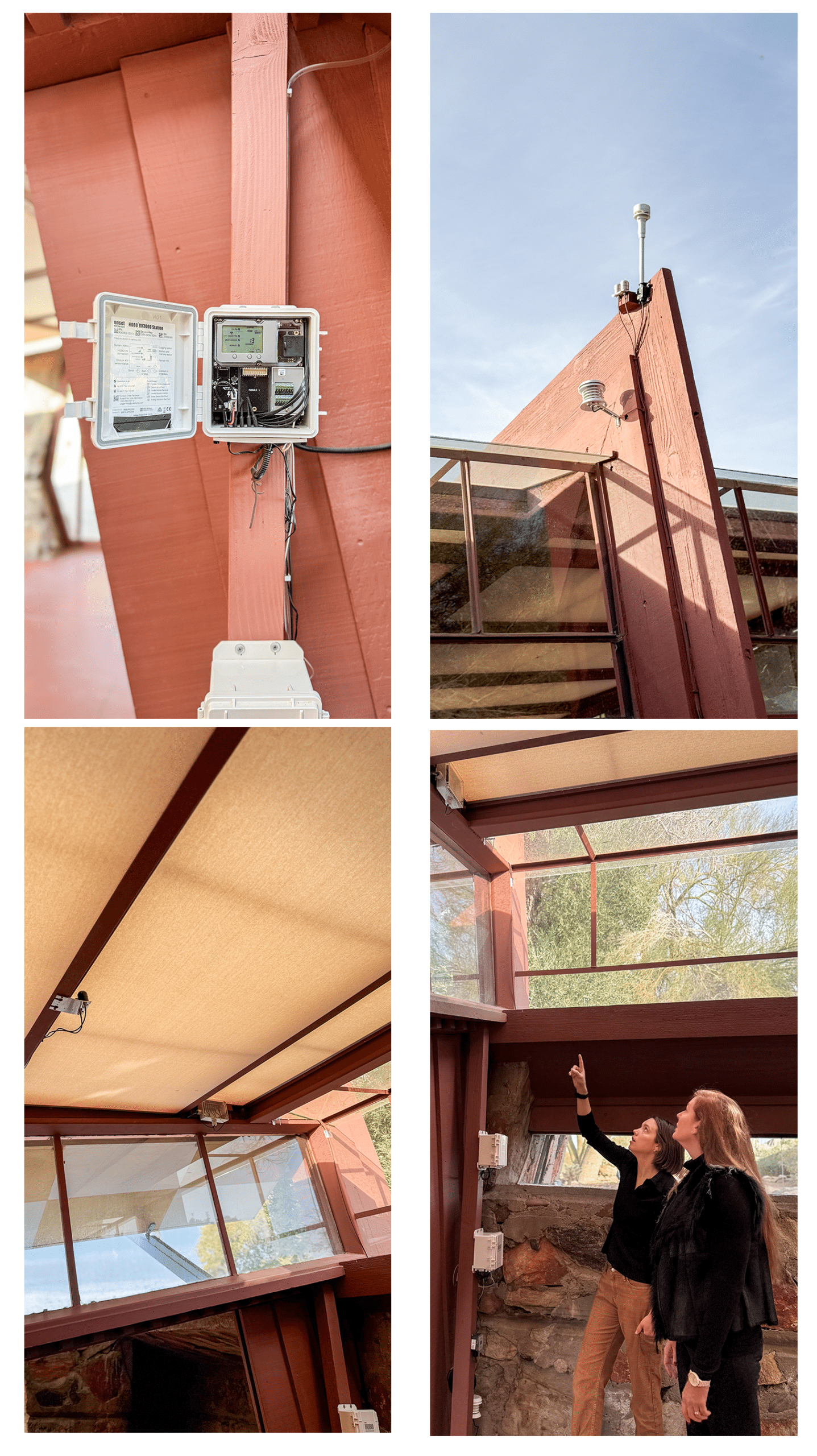
Barron and Gray discussing the equipment used to collect environmental data in Wright’s office to create an energy model, by Evan Oskierko-Jeznacki in consultation with Watson & Henry Associates. This model was used to test their assumptions about different fabric options and develop a baseline from which they can measure the success of the new system in the future.
JG: Are you also planning to remove the glass when the fabric roof is installed?
RB: Yes, our intention is to remove the glass. But since we are open to visitors all year, we have to make some modifications. For example, this new roofing system is designed to be more air and watertight when the panels are closed, helping to keep the air conditioning in and the rain out. Wright was not here during the heavy rains of the summer monsoon season. During his lifetime, he and the apprentices would just cover up their work and wait it out.
JG: What aspect of the fabric roof project excites you most?
RB: That historic preservation can be a way of thinking about our future, as much as preserving our past. As a UNESCO World Heritage Site and National Historic Landmark, there is an expectation of permanence, that Taliesin West must be preserved for future generations. And yet, Wright never resolved the tension between permanent and temporary, monumental and ephemeral which are defining characteristic of this site. Arguably, we will never resolve this tension, nor should we. Taliesin West is a remarkable case study for thinking about architecture and heritage in a desert environment, especially as desertification expands globally due to climate change. Much attention has been paid to rising sea levels and their impact on coastal heritage sites, but the conversation is just beginning for harsh arid, desert climates.
One of the reasons we decided to pilot the fabric roof project in Wright’s office rather than at a remote location was so that visitors would be able to join along for the process, to learn more about responsive design and values-based preservation. Using the site as an educational tool is important. I believe that Taliesin West can continue to be a laboratory for engaging new ideas about critical heritage, climate adaptation, and architectural experimentation, and inspire us to consider more imaginative and holistic ways that we can live with our environments. ■
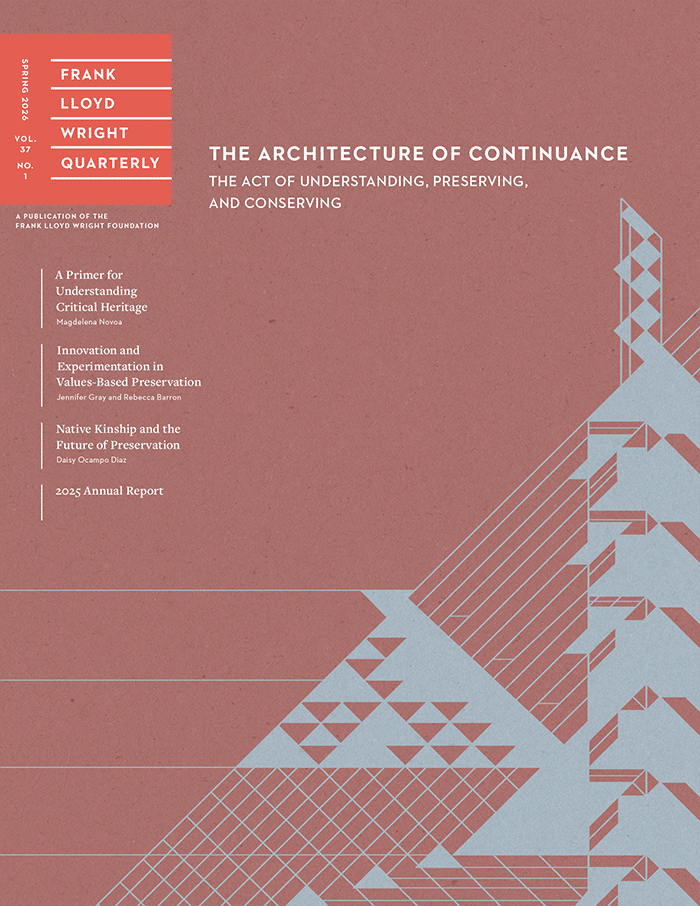
This article originally appeared in the Spring 2026 issue of the Frank Lloyd Wright Quarterly magazine, “The Architecture of Continuance: The Act of Understanding, Preserving, and Conserving.”
Join the Frank Lloyd Wright Foundation to receive a subscription to Frank Lloyd Wright Quarterly as part of your membership benefits. Become a member today to stay connected and inspired.