Winter At Taliesin
Rebecca Hagen | Dec 23, 2025
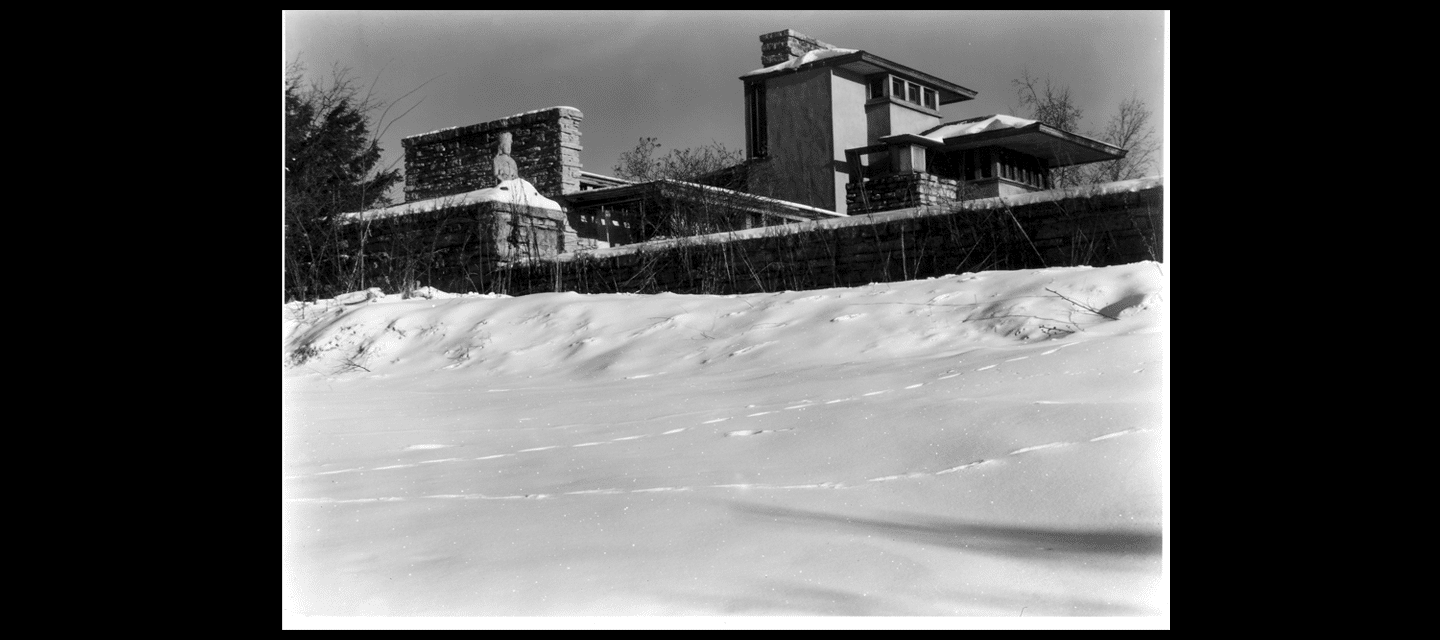
A Chinese Guanyin statue in the snow, ca. 1940, photograph by Edmund Teske. Frank Lloyd Wright Foundation Archives (Avery Architectural Library at Columbia University and the Museum of Modern Art) 2501.1027.
Winter can be a challenging part of the year for Taliesin in Spring Green, Wisconsin. The process of preparing for winter may have changed somewhat since Wright lived here, but staff take many of the same steps the apprentices did to keep the place safe from the harsh elements.
All the major buildings at Taliesin were originally intended to be used during the winter and were built with relatively robust heating systems. The Hillside Home School ran throughout the winter, and Wright spent large portions of the winters from 1912-1936 at his Wisconsin home. Wright claimed that Taliesin continued to be cozy and warm despite its many windows and exposed position on the brow of the hill.
“Winter nights- all in the white, outside- we love to build a wood fire in the big stone bedroom fireplace, close the inside wood shutters of the whole house, and lie story-telling [sic] or reading until we fall asleep. We sometimes take turns reading aloud, Iovanna’s fairy-tales [sic] coming first. Carl [Sandburg]’s “The White-Horse Girl and the Blue Wind-Boy” is her favorite at the moment. And ours.” (Frank Lloyd Wright, An Autobiography, 1932.)
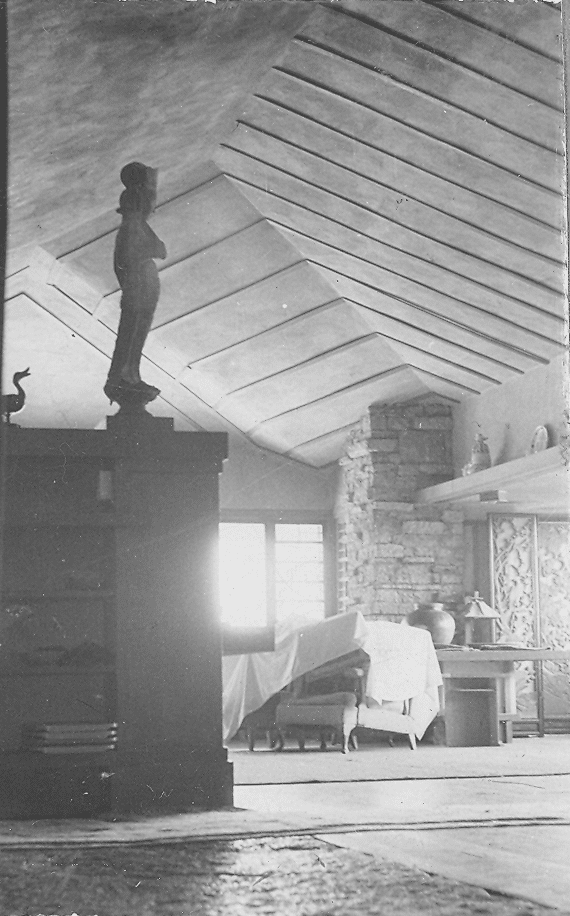
Taliesin Living Room with furniture covered in sheets, ca. April 1945, photograph by Mat Kauten, Frank Lloyd Wright Foundation Archives (Avery Architectural Library at Columbia University and the Museum of Modern Art) 2501.1560.
By choice, the winter of 1936-1937 was Wright’s in Wisconsin and construction began on his new home and studio, Taliesin West, in early 1938.
With Taliesin West, Wright began implementing changes to Taliesin that made it more appropriate for the summer months. These alterations included the addition of more windows and doorways to outdoor terraces. In the following years, the Fellowship settled into a regular rhythm of usually leaving Wisconsin around Thanksgiving and returning in early May, with only a small group left behind to care for the site.
To protect the items in Frank Lloyd Wright Foundation Collections from snow and ice, we take steps to protect them from the elements, including covering furniture in cotton sheets like the Fellowship did historically. We also cover or move inside outdoor objects.
Several of our historic buildings are not heated during the winter and do not have winterized pipes, so the water service must be shut off every November. Many of our drains are fitted with heat tape to ensure that ice dams do not create flooding hazards when the snow melts. We install additional stretchers in the Hillside Drafting Studio to ensure the roof can safely handle a heavy snow load.
Due to its damaging nature, we cannot use salt to melt ice. Instead, we use sand to provide traction in slippery areas and do our best to shovel the snow as it comes. For all its challenges, winter has its unique beauties which Taliesin wears with pride, as described best by Wright himself in his autobiography:
“I wanted a home where icicles by invitation might beautify the eaves. So there were no gutters. And when the snow piled deep on the roofs and lay drifted in the courts, icicles came to hang staccato from the eaves. Prismatic crystal pendants sometimes six feet long, glittered between the landscape and the eyes inside. Taliesin in winter was a frosted palace roofed and walled with snow, hung with iridescent fringes, the plate-glass of the windows shone bright and warm through it all as the light of the huge fire-places [sic] lit them from the firesides within, and streams of wood-smoke from a dozen such places went straight up to the stars.” (Frank Lloyd Wright, An Autobiography, 1932.)
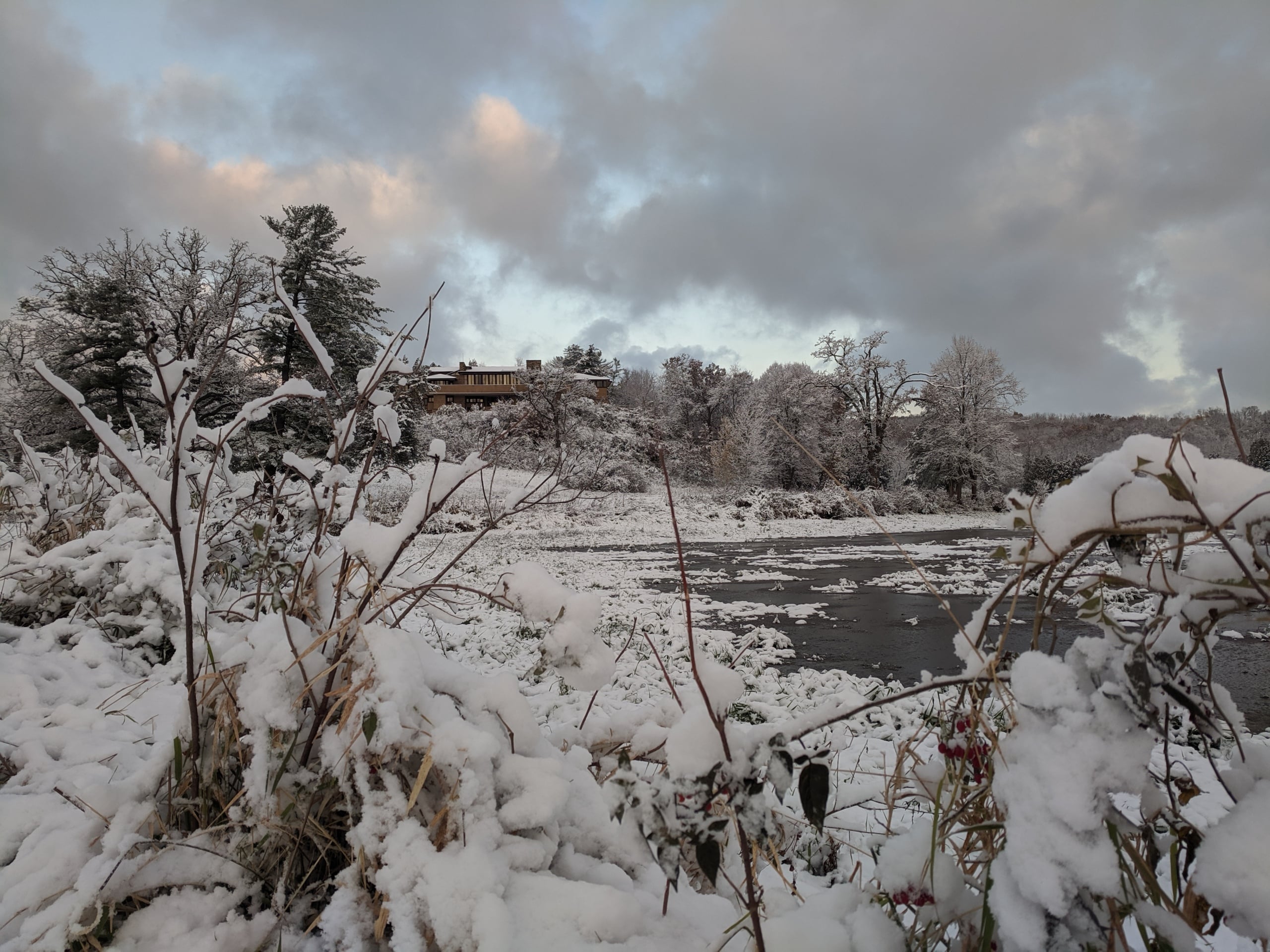
Taliesin from the pond during the first snow of winter 2019-2020.